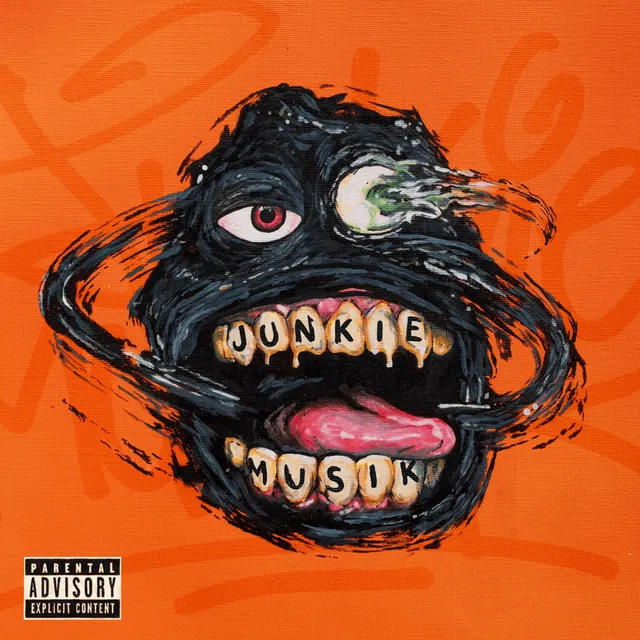
Kopi luwak is the most expensive coffee in the world precisely because of its route: eaten by a civet, passed through its gut, collected, washed, sold at gold prices. The song adopts that route as its whole economics — "la mia shit kopi luwak," my shit is kopi luwak — and uses it to argue that everything these rappers touch undergoes the same conversion. (English renderings below are interpretive translations of the Italian lyric, not an official translation.)
Luxury that passed through an animal
Kid Yugi's verse runs the conversion machine at full speed: from the fields to the ghetto, "super cervello come Sheldon," salary that "sfonda il tetto" — smashes through the ceiling — money described as "gay" because "fanno un arcobaleno," it makes a rainbow. The imagery is deliberately overclocked: snow in July, four women in the bed, records pulverized.
Under the boasting the verse keeps its receipts: "Da bambino mi mancava l'affetto" — as a child I lacked affection — and the promise that his promises "le porta via il vento," the wind carries away. The machine that converts filth into luxury runs on deficits that luxury cannot repay. Even his doubt gets a classical citation — "il dubbio di Amleto" — Hamlet's hesitation dressed as a street decision.
Sit at the table or be on the menu
Marracash's chorus compresses the song's ethics into one proverb: "Se non sei seduto al tavolo che mangi, allora sei nel menù" — if you're not seated at the eating table, you're on the menu. It is the zero-sum rule that justifies everything else, and the chorus's escalation — "Ero un bastardo come gli altri, ora ancora di più" — I was a bastard like the others, now even more so — presents moral worsening as the price of the seat.
His verse applies the rule personally: "Questa corona non mi fitta" — this crown doesn't fit me right — and "Non mi prendere da esempio, frate'" — don't take me as an example, brother. The man at the table warns the hungry not to copy his route. That tension — victory narrated with a caution sticker — is the song's most adult gesture.
The terror of love
The second pre-chorus breaks the song's armor: "Armi, droghe o la prigione, brother, sono cose spaventose / Però, giuro, non c'è niente che mi faccia più terrore dell'amore" — guns, drugs, or prison are frightening things, but nothing terrifies me more than love. After two verses of conversion machinery, the one substance the machine cannot process is named.
It reframes the title. Everything in the song can be eaten, digested, and sold at a markup — everything except the one thing that eats you. The closing pun, "Kiss, Giuda" — a kiss, Judas — folds love and betrayal into the same gesture, which is as close as the song gets to explaining its own fear.
"KOPI LUWAK" works because its metaphor is honest about the process. The luxury is real, the gut it passed through is real, and the song never pretends the washing removed the taste.
This article is an independent interpretation of the lyrics and metadata listed above, not an official statement of the artists' intent. Translations are interpretive. It does not reproduce the full lyrics. Source and credits: Genius.