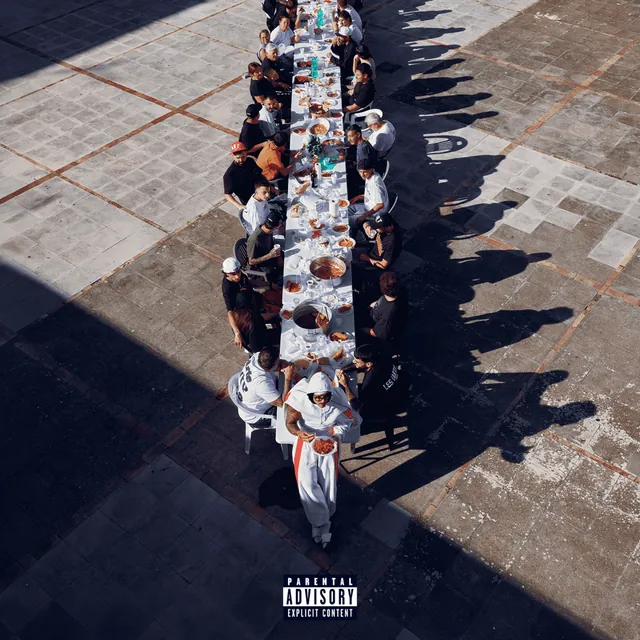
The intro is a parable in miniature. A brother warns that nobody can win forever; the narrator answers that he proved the brother wrong "by force, because I keep winning" — and if he wins, the brother wins too. The claim "e vuje pusate 'sti pistole ca songo a salve" — put down those guns, they're firing blanks — dismisses the skeptics before the beat even settles. The song's credits list an expected date of October 2, 2026 for the album.
Not understood — and it's not the language
The pre-chorus carries the song's most quoted line: "I' nun vengo capito e nn'è pe via d''a lingua, picciò nn'me capisceno" — I am not understood, and it is not because of the language; they just don't understand me. Singing that in Neapolitan on a chart-topping record is the argument and the proof at once. The follow-up jokes keep the same register of self-sufficiency: the phone on airplane mode "worse than TIM," and bad grades in math redeemed by multiplying everything by a thousand.
Take it, nobody hands it to you
The chorus is a philosophy of acquisition: "Pigliate chello che vuò pecché nisciuno s''o leva pe'tté" — take what you want, because no one takes it off the shelf for you; "nisciuno se ne fotte 'e te" — nobody cares about you. It is the streets' version of self-help, stripped of comfort. The second half of the chorus adds the cosmology: heaven can be touched with your hands, "ma l'inferno c''a punta d''a scarpa" — but hell with the tip of your shoe. Grace is reachable; disgrace is even closer and takes less effort.
The word "winner" is never defined in the lyrics; the song defines it behaviorally — sold-out shows "venenno venenno, pazzianno pazzianno" (selling and selling, going crazy), a contract to sign, money counted by eye rather than by hand.
The idol up close
The second verse tells the classic backstage story with a twist: "L'idolo mio tene 'o cugnome mio" — my idol has my surname — "pecché l'idolo mio l'aggio visto 'a vicino / E llà ha fernuto 'e essere l'idolo mio": because I saw my idol up close, and there he stopped being my idol. Proximity demystifies; afterward the narrator "aggio fatto cchiù cose 'e l'idolo mio," did more than his idol did. The punchline about writing "with grammatical errors" and receiving "diece e lode" for it winks at every critic who mistook dialect for mistakes.
Heaven by hand, hell by shoe tip
"WINNER" stays local to the end: mother cooking "'o rraù" while money comes and goes "tipo oplà," faster than a subway. The Neapolitan frame is not decoration but method — a song arguing that nobody will hand you anything, delivered in the very dialect the mainstream once treated as a handicap. Winning, the record suggests, sounds like this: untranslated, unbothered, and counted out loud.
This is an original English interpretation of the supplied lyrics and translation pages, not an official explanation. Neapolitan lines are quoted briefly for commentary; full lyrics are not reproduced. Source: Genius.