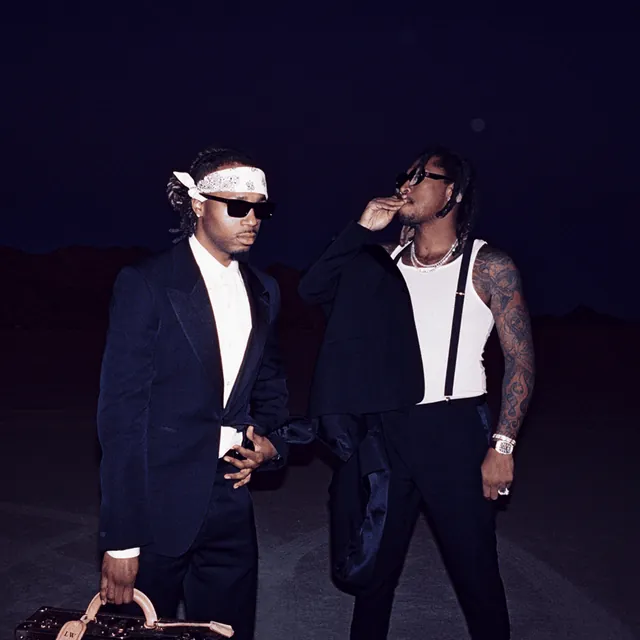
The song is structured as an interrogation that turns into a detonation. Future spends his sections defining "like that" — a standard of street credibility, spending, and appetite — and Kendrick Lamar spends his verse seizing the standard and declaring himself its only living measure. The Michel'le sample, "he was once a thug from around the way," hangs over both like a memory of where the standard came from.
Is you like that?
The chorus is a checklist delivered as a challenge: selling, kicking doors, stepping in Balencis, popping bottles — "is you like that?" The question never asks whether the life is good; it asks whether the listener's life matches the description. Belonging is the currency, and the question is the bouncer.
Future's verse fills in the cost of admission: code-keeping ("stickin' to the code"), women treated as accessories and liabilities, shooters posted "in the corner like the pack in." The images are deliberately joyless for all their wealth — chains, carats, and "she get fucked for a chain" — a world where everything, including loyalty, has an exchange rate.
First-person shooter
Kendrick's verse enters as a refusal of ceremony: "Don't pull no coffin out of your mouth, I'm way too paranoid for a threat." Talk is disqualified on arrival. Then the song's most quoted line: "Motherfuck the big three, nigga, it's just big me." The hierarchy the culture had been debating is dismissed as arithmetic error — there is no list, there is a person.
The verse frames the attack as self-defense with a memory: "Lost too many soldiers not to play it safe... I still got PTSD." The aggression is presented as hypervigilance, which is the verse's most honest claim — the violence in the language is priced as aftermath, not appetite. Even the jokes carry the theme: "I crash out like, 'Fuck rap,' diss Melle Mel if I had to" treats rap history itself as fair game, lineage be damned.
"Your best work is a light pack" and "Prince outlived Mike Jack'" do the verse's cultural bookkeeping: rivals' peaks are reassessed as small weights, and longevity itself is drafted as evidence. Whether or not the listener accepts the verdict, the verse's real subject is what it costs to insist on being the measure of everything.
The code underneath
Future's outro returns to the beginning — "Came in banging dope, niggas was young, slangin' powder" — and the Michel'le sample's "he was once a thug from around the way" completes its arc: nostalgia for the corner as origin story. The Phantom and the driver are the proof, but the tense stays past.
That is the song's final tension. The chorus asks if you are "like that" in the present; the outro answers in the past; Kendrick's verse claims the present tense by force. "Like That" is less a celebration than a custody battle over what authenticity means — and it ends with all three versions still audible at once.
This article is an independent interpretation of the lyrics and metadata listed above, not an official statement of the artists' intent. It does not reproduce the full lyrics. Source and credits: Genius.