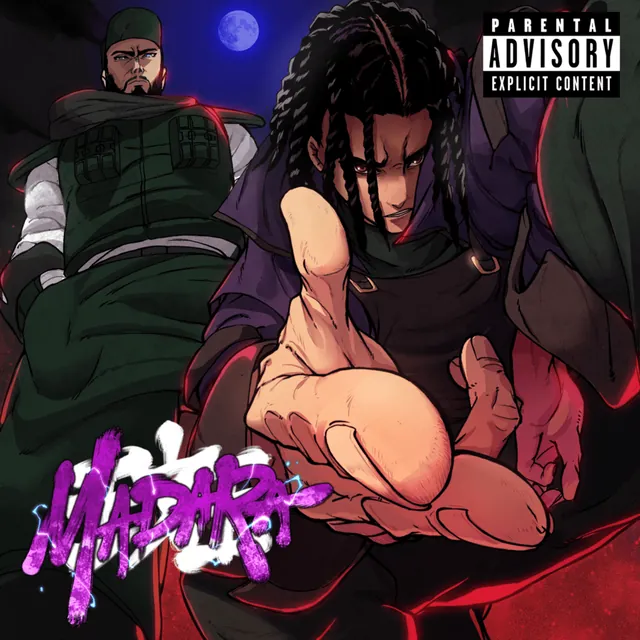
The song borrows its name from anime's most famous resurrected antagonist, and the borrowing is the concept: villainy as a craft you train for, a body that won't stay buried, a power that chose you because you once loved the people who hate you. Each performer takes the frame at a different distance — Ez Mil as the rising fighter, the interludes as the villain's inner voice, Eminem as the legend who has already outlived his enemies.
The dojo and the costume
Ez Mil's verse is a gym session disguised as a diss. Challengers "wanna rap like you been in a dojo" and "personify Gojō" — cosplay fighters borrowing the aura of invincible characters. His counter is speed and appetite: chewing a Tic Tac, getting chicken for dinner, "runnin' laps on slowpokes," the Japanese asides (hayaku — faster) working as both taunt and metronome.
The verse's verdict is economical: "You never really was no killer / If I was honest, I'd say y'all the beginners." The dojo language matters because it reframes rap competition as martial discipline — belts, training, lineage — rather than mere noise. The beginner's mistake is treating the costume as the skill.
The villain's creed
Hideyoshi's chorus and interludes supply the frame's dark interior: fragments about reality and suffering that won't resolve — "wakaranai," I don't understand — and a sneering challenge to anyone who thinks they can fight. Then Neil Kaplan's spoken passage delivers the album of villainy in one breath: "Hope is just a word for those who choose to give up daily... Power chose me, for I once loved those who hate me."
That last line is the creed's hinge. The villain's authority is presented as the residue of betrayed love — blood spilled by those he cared about. It is mythology, not confession, but it explains the song's choice of mask: the antagonist is the character whose power is legible as woundedness, scaled up until it fills the sky.
Eminem's ledger of survival
Eminem's verse enters as the frame's proof of concept — the rapper who has actually been the villain of the culture for decades. The technical showboating (spina bifida into "pretend this a spine," a blind dentist with misdesigned Invisalign) is the point rather than decoration: control of the verse stands in for control of the fight.
Underneath the wordplay runs a career retrospective: being put on by Dre when he "thought he was pulling my leg," nonbelievers "fuelling my rage," and the retrospective verdict on every feud — "it wasn't murder, just suicide, 'cause really, they all got themselves killed." The closing Spielberg joke, needing "a whole lot of Emmys" for the bodies in the morgue, converts the body count into awards-season hardware.
Read whole, "MADARA" is less about anime than about what the villain figure licenses: unlimited aggression, framed as endurance. The song asks its rappers to be hated on record and answers with the villain's consolation — being hated, survived, and still standing is the whole résumé.
This article is an independent interpretation of the lyrics and metadata listed above, not an official statement of the artists' intent. It does not reproduce the full lyrics. Source and credits: Genius.