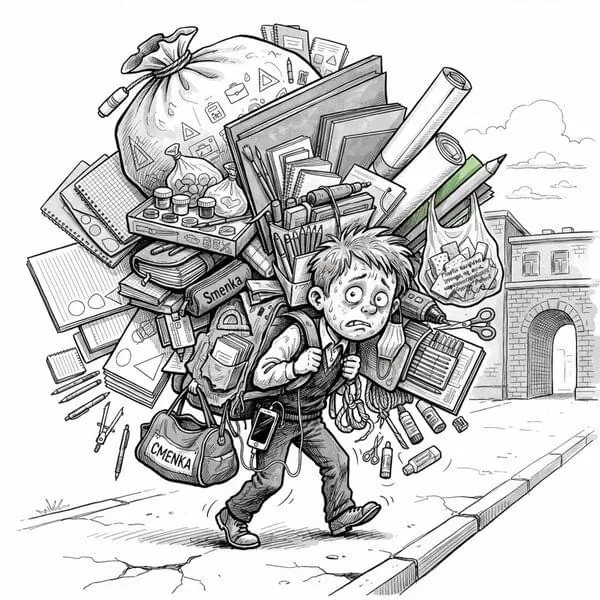
The verses are lists, and the lists are the joke. "Тетрадки в клеточку, в линеечку, в кружок и в пирожок" — notebooks squared, ruled, circled, and (with a wink) in "pirozhok" shape — opens an inventory that never seems to end: plasticine and watercolors, ten shared notebooks, three pencil cases, gel pens by the handful, compasses and protractors, a backpack with a power bank.
The endless school list
What makes the catalogue funny is its accuracy. Anyone who has assembled a school kit will recognize the surreal specificity — "три корректора беленьковых" (three little white correction pens), gym sticks and skis, special socks for running. The rhythm of the delivery piles item on item faster than the ear can file them, reproducing the experience of a shopping list that reproduces itself.
One surreal detail keeps peeking through the stationery: "она танцует под Sade" — she dances to Sade. In the middle of the school-supply avalanche sits a person, and she has taste.
Twenty kilograms of books
The chorus is the song's thesis, a schoolyard chant with a scale attached: "В школу носит ученик двадцать килограммов книг" — a student carries twenty kilograms of books to school — plus spare shoes, pens, and a diary, "если дождик — дождевик," if it rains, a raincoat. The absurdity is not the number; it is that everyone agrees the number is normal. The chant format suggests the kids themselves have already turned the burden into folklore.
Dancing to Sade
The "she" who dances to Sade gives the song its warmth. Whether she is a classmate, a daughter, or the mother organizing the lists, she is the human unit inside the metric system of school supplies. Against Sade's smooth adult sophistication, the twenty kilograms of textbooks feel even more absurd — childhood as an earnest, overloaded pilgrimage toward someday getting to choose one's own soundtrack.
Chipping in for desks and doors
The second verse quietly radicalizes the joke. After the personal supplies comes the collective ask: "скинуться пора на парты" — it's time to chip in for desks — and then, in the same breath, "на шкаф, люстры, мел, цветы в горшках / Плитку, окна, тюли, дверь" — for cabinets, chandeliers, chalk, potted plants, tiles, windows, curtains, a door ("она сломана? Проверь" — it's broken? Go check). The list of what families must fund has slipped from pencil cases to the building itself.
That slide is the song's real subject, delivered with a straight face: the everyday comedy of a school system quietly outsourced to shopping. By the final chorus the twenty kilograms feel like the lightest part of the load — and the chant keeps bouncing, because laughing is lighter still.
This is an original English interpretation of the supplied lyrics and translation pages, not an official explanation. Russian lines are quoted briefly for commentary; full lyrics are not reproduced. Source: Genius.